Inquiry
Form loading...

7 Best Sweeper Vacuums for Commercial Buyers

Commercial cleaning rarely happens on a spotless showroom floor. A Sweeper Vacuum must handle dust, paper scraps, grit, and sudden spills. It may work across warehouse aisles in the morning and retail entrances by afternoon. That changing workload exposes weak batteries, narrow cleaning paths, and awkward controls quickly.

This guide examines seven Sweeper Vacuum models for commercial buyers. We compare collection capacity, brush performance, filtration, noise, runtime, maneuverability, and maintenance demands. We also consider practical details, such as emptying a full hopper beside a loading dock or steering around crowded display racks. No machine wins every floor. A compact unit may suit a hotel corridor but struggle with coarse warehouse debris. A powerful model may clean faster, yet require more storage space and training.

Our recommendations focus on dependable operation, clear specifications, replacement-part access, and realistic ownership costs. Manufacturer claims matter, but they do not tell the entire story. Operator comfort, floor conditions, and cleaning schedules can change the result. Some rankings may remain debatable. That is worth admitting.

Buyers should confirm surface compatibility, battery charging requirements, filtration standards, warranty coverage, and service support before purchasing. A lower upfront price can become expensive when brushes wear quickly or downtime interrupts a contract. The best choice is not always the largest or fastest machine. It is the one that matches the site, staff, debris, and expected workload without creating new problems.
7 Best Sweeper Vacuums for Commercial Buyers

Commercial Sweeper-Vacuum Types: Seven Configurations for Buyer Comparison

Commercial buyers need more than a long feature list. The machine’s configuration should match floor size, debris type, access limits, and cleaning frequency.

Field experience shows that a poor match creates higher labor costs, even when the vacuum itself performs well.

A walk-behind sweeper-vacuum suits narrow aisles, retail floors, and small warehouses.

A ride-on model covers large, open areas faster, but needs turning space and trained operators.

A compact battery unit works well in public buildings where noise and exhaust are concerns. Its runtime may disappoint during long shifts.

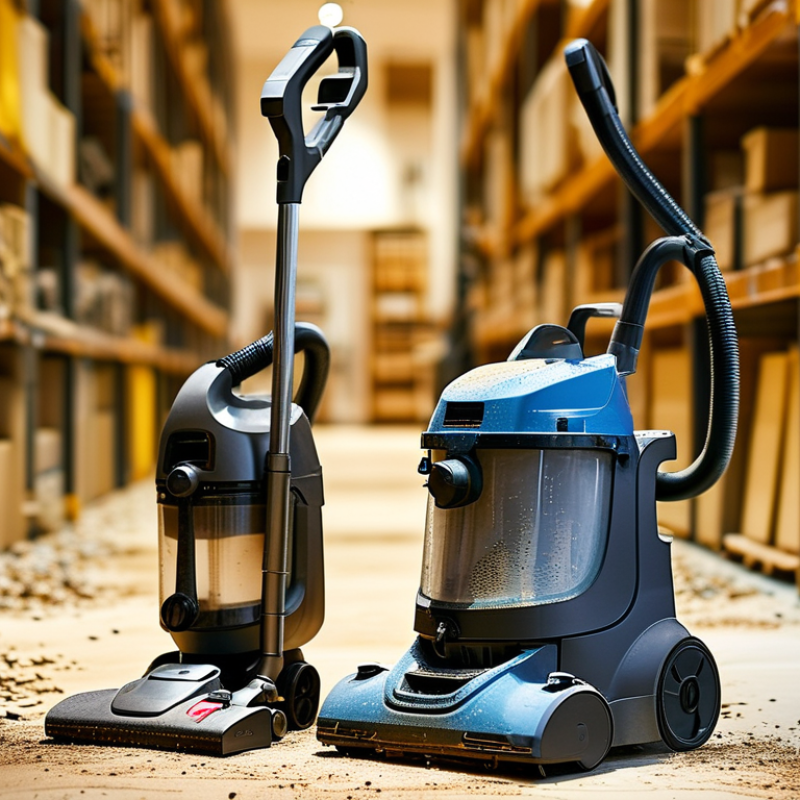
A wet-dry industrial vacuum handles liquid spills, fine dust, and heavier debris. Check filtration and tank drainage before purchase.

A tow-behind sweeper-vacuum can serve yards, parking areas, and large outdoor sites, but its towing vehicle adds operating complexity.

A truck-mounted configuration offers high capacity for municipal or industrial work, although maintenance access can be less convenient.

The seventh option, a remote-operated sweeper-vacuum, helps in repetitive or restricted areas, yet controls and sensor upkeep require careful planning.

Compare cleaning width, suction performance, filter replacement, battery charging, noise, and operator visibility.

Ask for a floor trial with your actual debris. Dust, gravel, packaging scraps, and damp residue behave differently.

Specifications can look convincing. Site conditions often expose their weaknesses.

Allow space for service access, because an efficient machine becomes a liability when routine cleaning is awkward.
Dust-Control Standards: OSHA’s 50 μg/m³ Silica PEL and HEPA’s 99.97%

Commercial buyers should judge sweeper vacuums by dust control, not just cleaning speed. OSHA’s respirable crystalline silica PEL is 50 μg/m³, measured as an eight-hour time-weighted average. A machine that gathers visible dust may still leave fine particles suspended near workers’ breathing zones. That difference matters on concrete floors, masonry sites, and renovation projects.

HEPA filtration can capture 99.97% of particles at 0.3 microns under test conditions. However, HEPA alone does not prove OSHA compliance. Buyers should check airflow, sealed hoses, filter-loading indicators, and documented test results. In daily use, a clogged filter can reduce suction and increase airborne dust. We have seen clean-looking equipment perform poorly after careless maintenance. It is an easy detail to overlook.

Tips: Choose sealed collection systems and confirm the unit’s respirable-dust rating. Inspect filters before every shift. Empty containers slowly, preferably with closed bags or suitable dust controls. Record maintenance and worker exposure checks. A short floor trial can reveal leaks, awkward handling, or rapid filter blockage. Do not rely on the 99.97% figure without checking its test standard and operating conditions. Even experienced teams sometimes treat certification as a substitute for measurement. It is not.

Productivity Metrics: Cleaning Width, m²/h, CFM, and Battery Runtime

7 Best Sweeper Vacuums for Commercial Buyers

Productivity starts with cleaning width, not advertising claims. A 60 cm machine moving at 4 km/h has a theoretical rate of 2,400 m²/h. Real output falls after turning, emptying, and avoiding obstacles. A 60% utilization factor reduces that figure to about 1,440 m²/h. ISSA’s 612 Cleaning Times benchmark also stresses task conditions, travel, and setup time. The math looks clean. Real floors are not.

CFM measures airflow, but higher CFM does not automatically mean better sweeping. Compare airflow with brush design, filtration, dust loading, and pickup performance. Battery runtime needs similar caution. A quoted six-hour runtime may exclude aggressive brush settings or repeated acceleration. Track usable runtime during a normal shift, then measure square metres completed per charge. A 2024 commercial cleaning equipment market analysis from Grand View Research identifies labor efficiency and battery operation as major purchasing drivers, but market projections cannot replace site testing.

Tips: Measure a 100 m² route with shelving, corners, and doorways. Record minutes, collected debris, battery percentage, and operator fatigue. Repeat the test twice. I would also question one perfect trial; clean aisles can hide poor performance around loading areas. Compare effective m²/h, not the maximum figure printed on a specification sheet. Short trials often flatter machines.

Total Cost of Ownership: Labor, Filters, Maintenance, and Five-Year Costs

Commercial buyers comparing seven sweeper vacuums should calculate ownership costs, not just purchase prices. A low-cost machine can consume more labor through slow passes, frequent emptying, or awkward controls. In a 10,000-square-foot warehouse, five extra minutes per shift can exceed 100 labor hours annually. At a loaded rate of $25 per hour, that delay costs roughly $2,500 each year. These are estimates, not promises. Actual results depend on debris, floor layout, and operator training.

Filter costs deserve equal attention. Fine dust can clog filters quickly, reducing suction and forcing longer cleaning cycles. A washable filter may lower replacement spending, but it still needs drying time and careful inspection. Budget for two spare filters per unit during the first year. That assumption may be excessive. It is safer than stopping a shift because one filter is damaged.

Maintenance includes brushes, belts, batteries, chargers, wheels, and service visits. Record replacement intervals from real use, rather than relying only on sales literature. Battery replacement can reshape the five-year figure, especially in daily operations. Divide every projected expense by expected cleaning hours. A machine costing $4,000 upfront may reach $12,000 over five years after labor, parts, filters, and downtime. Track actual invoices quarterly. Small errors become expensive.

7 Best Sweeper Vacuums for Commercial Buyers - Total Cost of Ownership: Labor, Filters, Maintenance, and Five-Year Costs
Configuration Cleaning
Path
Power
Source
Rated Runtime
or Duty Cycle
Productivity
(sq. ft./hour)
Purchase
Price
Estimated Annual Operating Costs Estimated
Five-Year TCO
Labor
Hours
Labor Cost
(at $24/hour)
Filters & Bags Maintenance
& Wear Parts
Energy or
Fuel
1. Compact Corded Sweeper Vacuum 18 in 120 V corded Continuous 15,000 $1,600 620 $14,880 $120 $300 $180 $79,000
2. Battery Walk-Behind Sweeper Vacuum 24 in 24 V battery Up to 3.5 hours 22,000 $4,200 400 $9,600 $240 $750 $260 $58,450
3. Heavy-Duty Battery Sweeper Vacuum 28 in 36 V battery Up to 4 hours 30,000 $6,800 300 $7,200 $360 $1,100 $420 $52,200
4. Ride-On Sweeper Vacuum 34 in 48 V battery Up to 5 hours 45,000 $14,500 170 $4,080 $480 $2,100 $760 $51,600
5. Dual-Brush Battery Sweeper Vacuum 30 in 36 V battery Up to 4.5 hours 36,000 $8,900 250 $6,000 $420 $1,300 $500 $50,000
6. High-Filtration Battery Sweeper Vacuum 26 in 24 V battery Up to 3 hours 25,000 $7,600 330 $7,920 $900 $1,400 $460 $61,000
7. Combustion-Powered Outdoor Sweeper Vacuum 32 in Petrol engine Up to 6 hours 40,000 $12,500 210 $5,040 $540 $2,300 $1,500 $59,400
Costing assumptions: Estimates are intended for commercial budgeting and comparison. Five-year TCO equals purchase price plus five years of labor, filters and bags, maintenance and wear parts, and energy or fuel. Labor is modeled at $24 per hour for 1,000,000 square feet of cleaning per year. Purchase prices and operating costs are representative market-planning estimates and exclude taxes, freight, financing, floor preparation, and battery replacement beyond normal maintenance.

Selection Matrix: Facility Size, Debris Type, Noise, and Duty Cycle

7 Best Sweeper Vacuums for Commercial Buyers

The best commercial sweeper vacuum depends on facility size, debris type, noise limits, and duty cycle. For small offices, compact machines usually provide better control around desks and narrow corridors. Large warehouses need wider cleaning paths, larger hoppers, and batteries that survive extended shifts. A bigger machine is not always better.

Fine dust requires effective filtration and sealed airflow. Coarse debris, such as packaging scraps or grit, needs a durable brush system and an easy-empty collection bin. Noise also matters in hospitals, hotels, and occupied offices. Check the rated sound level, but test it on hard floors when possible. Real conditions can sound different.

Tips: Build a simple selection matrix before purchasing. Score each model from one to five for facility area, debris load, noise, runtime, maintenance access, and operator comfort. Ask suppliers for duty-cycle data, not only maximum runtime. Inspect brush wear after repeated use. A machine that cleans quickly may still lose value if filters clog daily. I would also leave space for judgment. Staff walking patterns, floor texture, and seasonal debris can defeat a perfect spreadsheet. Test one unit during a normal shift before ordering several. Small trials reveal awkward controls, poor visibility, and charging delays that brochures often miss.

7 Best Sweeper Vacuums for Commercial Buyers — Selection Matrix

Comparison of representative commercial equipment classes using facility coverage, debris capacity, noise comfort, and duty-cycle suitability.

Scores are normalized from commonly published commercial operating ranges: coverage area, hopper capacity, measured sound pressure, and recommended daily operating time. Higher scores indicate stronger suitability; the noise score is inverse-rated, so quieter equipment receives a higher score.