Choosing the right Electronic Clock supplier requires more than comparing unit prices. Global buyers need dependable timing, stable displays, careful assembly, and responsive communication. A factory may look impressive online, yet real performance appears under daily use. Ask for product samples, test reports, production photos, and clear warranty terms.
John C. Taylor, a British engineer, inventor, and renowned clockmaker, has said, “A clock should make people think about time.” His view reflects an important purchasing lesson. An Electronic Clock is not merely a glowing number panel. It may hang above a busy warehouse, sit beside a hotel reception desk, or guide workers through a factory shift. Accuracy, readability, power stability, and housing strength all matter.
A capable China-based supplier should offer practical customization. Options may include LED or LCD displays, 12-hour or 24-hour formats, calendar functions, temperature readings, remote control, and different mounting methods. Experienced suppliers can also support OEM branding and packaging. However, buyers should not accept every claim without verification. Specifications sometimes sound better than real samples.
Look closely at brightness uniformity, button response, cable quality, and performance after continuous operation. Check whether the supplier explains quality control clearly. Certifications should match the destination market and product type. Communication matters too.
Small details reveal experience.
No supplier is perfect. Even a strong factory can miss a detail or face component delays. Reliable cooperation depends on transparent correction, documented inspections, and realistic delivery promises. For global buyers, the best Electronic Clock supplier combines manufacturing capability with evidence, accountability, and steady support.
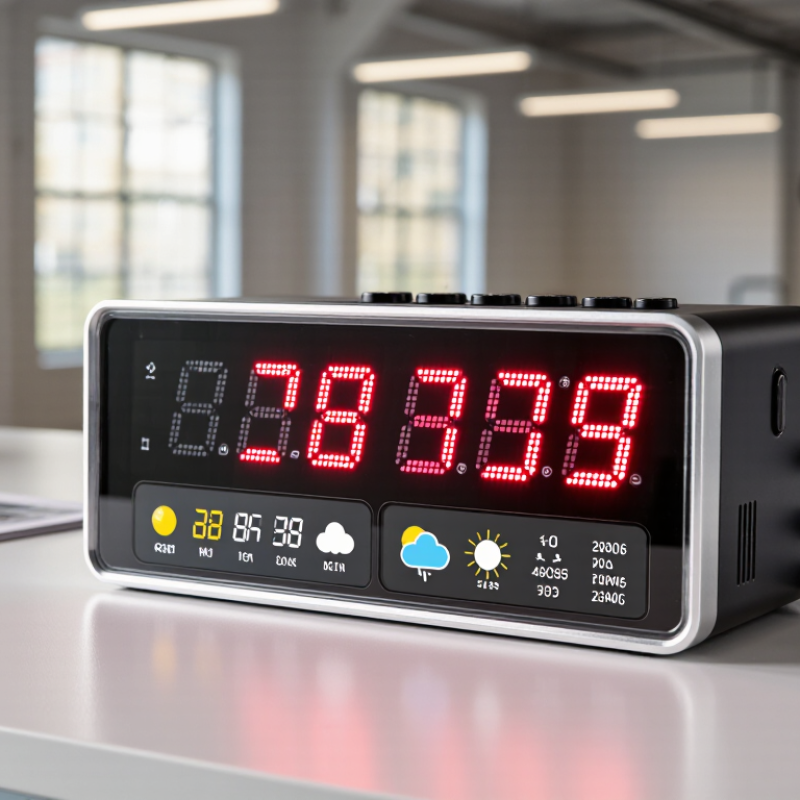
The electronic clock industry serves homes, offices, schools, transport facilities, and industrial sites worldwide. Global buyers now expect accurate timekeeping, clear displays, low energy use, and stable operation. In purchasing projects, I have found that readability often matters more than decorative design. A clock placed twelve meters away needs strong contrast, suitable digit height, and controlled brightness. Small details matter.
Market requirements differ by region and application. Buyers may request 12-hour or 24-hour formats, multiple language instructions, wall or ceiling mounting, and backup power. Products should also withstand local temperature changes, humidity, voltage differences, and shipping vibration. Reliable suppliers should provide test records, material details, user manuals, and consistent production samples. Compliance with applicable electrical, electromagnetic, and battery requirements must be verified before shipment. One overlooked cable can delay installation. That is a practical lesson.
Tips: Define the installation distance, viewing angle, power source, and operating environment before requesting quotations. Ask for a sample under real lighting, not only studio photographs. Check time drift during continuous operation. Confirm packaging strength with drop-test evidence when possible. Avoid choosing by price alone; however, expensive products are not automatically better. Some specifications remain unclear until field testing, so buyers should leave room for review and improvement.

A reliable China-based electronic clock supplier should make performance measurable, not merely promise low prices. Experienced buyers look for stable quartz modules, readable displays, accurate timekeeping, and durable housings. Ask for sample units before approving volume production. Check each clock after transport, overnight operation, and repeated button use. Small faults often appear late. That is expensive.
Supplier expertise also shows in quality control records. Request incoming-material checks, assembly inspections, aging tests, and final functional reports. A professional factory should explain tolerance ranges, battery behavior, display brightness, and failure handling clearly. Production capacity matters, but capacity without process discipline creates uneven batches. Confirm tooling ownership, packaging tests, spare-part availability, and realistic lead times. Keep specifications written.
Reliable communication is practical evidence of authority. The supplier should answer technical questions with drawings, test data, and corrective actions. They should support customization without hiding limitations. Compliance documents must match the actual model and destination requirements. Ask how complaints are logged and resolved. No supplier is flawless. A missed update can still happen, even with a strong process. What matters is transparent correction, traceable records, and willingness to review weak points. Buyers should compare samples from different production dates, because one successful unit proves little.
China Best Electronic Clock Supplier for Global Buyers
Electronic clocks now serve homes, offices, schools, hotels, and transport facilities. Common types include LED wall clocks, digital alarm clocks, countdown timers, desk clocks, and network-synchronized models. IDC reported that global smart home device shipments reached about 892 million units in 2023. This growth increases demand for connected displays and dependable timekeeping.
Technology choices affect accuracy and maintenance. Quartz modules suit basic clocks with low power use. Radio-controlled and network-synchronized systems reduce manual adjustment across multiple rooms. Some models add temperature, humidity, USB charging, or motion sensors. Wi-Fi and Bluetooth support remote configuration, but they also increase software and security requirements. The Internet of Things Analytics State of IoT report estimated 18.8 billion connected IoT devices in 2024. A clock may be simple, yet its connected function needs serious testing.
Customization can include casing size, LED color, font style, logo placement, packaging, language, plug design, and mounting methods. Buyers should request samples before approving mass production. Check brightness in daylight, viewing angles, battery performance, heat release, and power-failure memory. Factory quality records, component traceability, and electrical safety documentation matter. In practice, a beautiful prototype may fail after continuous operation. That lesson is easy to miss. Reported specifications should also match independent test results, especially for accuracy, standby consumption, and wireless performance.
A China-based electronic clock supplier earns global trust through repeatable quality control, not attractive claims. Incoming inspections should verify quartz movements, LED modules, batteries, adapters, and plastics against approved samples. Production teams can use AOI checks, calibration records, aging tests, and final-function inspections. Small details matter. A clock showing accurate time can still fail because of poor packaging or incorrect voltage labeling.
ISO’s 2022 Survey recorded 1,265,216 ISO 9001 certificates worldwide, showing how widely structured quality systems are used. However, certification alone proves little without traceability. Buyers should request batch records, corrective-action reports, and recent audit evidence. IEC 62368-1 may apply to powered clock products, while EMC, RoHS, and REACH requirements depend on the destination market. CE or FCC documentation must match the exact model, not a similar product. That distinction is often missed.
Environmental responsibility also deserves closer review. The Global E-waste Monitor 2024 reported 62 million tonnes of e-waste generated in 2022, with only 22.3% formally collected and recycled. Suppliers should therefore control battery access, material declarations, repair information, and recyclable packaging. Export experience helps, but it is not perfect. A supplier may pass an audit and still overlook a changed component. Independent testing, production samples, and shipment-level checks remain practical safeguards for international buyers.
| Evaluation Dimension | Relevant Requirement or Standard | Practical Supplier Evidence | Buyer Verification Point | Priority |
|---|---|---|---|---|
| Quality management system | ISO 9001:2015 quality management principles | Valid certificate issued by an accredited certification body; documented procedures for purchasing, production, inspection, and corrective action | Check certificate scope, validity, issuing body, and whether the manufacturing site is covered | High |
| Electrical safety | IEC 62368-1 may apply to audio/video, information, and communication technology equipment; the applicable edition depends on the destination market and product design | Safety test report covering the complete clock, power adapter, enclosure, insulation, and abnormal-operation tests | Confirm that the tested model, adapter, rated input, and production version match the purchased product | High |
| Electromagnetic compatibility | EU EMC Directive 2014/30/EU for products placed on the EU market, where applicable | EMC test report for emissions and immunity; technical documentation supporting the applicable conformity assessment | Verify test standards, laboratory accreditation, model number, and test configuration | High |
| Low-voltage safety | EU Low Voltage Directive 2014/35/EU generally covers equipment rated at 50–1,000 V AC or 75–1,500 V DC; applicability depends on the product input | Electrical safety report and EU Declaration of Conformity when the directive applies | Check the input-voltage range and confirm whether the clock or only the external adapter falls within scope | High |
| Restricted substances | EU RoHS Directive 2011/65/EU and Delegated Directive (EU) 2015/863, where applicable | Material declarations, supplier declarations, and laboratory screening for restricted substances such as lead, mercury, cadmium, hexavalent chromium, PBB, PBDE, and specified phthalates | Request evidence for plastics, cables, solder, coatings, batteries, and electronic components | High |
| Chemical compliance | EU REACH Regulation (EC) No 1907/2006, including Article 33 communication duties for Substances of Very High Concern above the applicable threshold | REACH declaration and current material-composition information from the supply chain | Confirm the declaration covers the finished clock, packaging, cables, coatings, and accessories | High |
| Battery and transport safety | UN 38.3 testing applies to lithium cells and batteries offered for transport; additional shipping rules may apply under air or sea transport regulations | UN 38.3 test summary, battery specification, packaging instructions, and transport classification when a lithium battery is included | Confirm battery chemistry, watt-hour rating, installation method, and shipping documentation | High |
| Timekeeping accuracy | The buyer should define an accuracy tolerance because performance varies by quartz movement, power source, temperature, and synchronization method | Calibration method, inspection records, operating-temperature range, and sample test results | Approve a written tolerance, such as a buyer-defined maximum daily deviation, before mass production | Medium |
| Display and functional inspection | Inspection criteria should be defined in the approved product specification and golden sample | Functional checklist covering display segments, buttons, alarm, backlight, synchronization, power recovery, and date or temperature functions where included | Require traceable inspection records and confirm that firmware settings match the approved sample | High |
| Incoming and process control | Documented controls for components, printed circuit boards, displays, adapters, housings, and packaging materials | Incoming inspection records, component lot tracking, first-article approval, and in-process inspection checkpoints | Check whether critical components can be traced from finished goods back to supplier and production lot | High |
| Final inspection and sampling | Use a written sampling plan; ISO 2859-1 provides attribute-sampling procedures based on lot size, inspection level, and AQL | Final inspection report with sample size, defect classification, AQL values, test results, and inspector approval | Agree critical, major, and minor defect definitions and acceptance criteria before production | High |
| Packaging and labeling | Packaging, markings, recycling symbols, importer information, and language requirements vary by destination market | Approved artwork, carton specification, barcode verification, drop-test records, and export labeling checklist | Confirm model, voltage, frequency, warnings, country-of-origin marking, manuals, and importer details | Medium |
| Technical documentation | Product specifications, risk assessment, test reports, declarations, user instructions, and change-control records should be consistent | Controlled technical file with revision history and product-to-report cross-reference | Check that all documents identify the same model, electrical rating, components, and manufacturing location | High |
| After-sales and corrective action | A documented complaint, warranty, root-cause, and corrective-action process supports consistent international supply | Warranty terms, spare-parts policy, response-time commitment, failure analysis, and corrective-action reports | Define response deadlines, replacement or credit rules, and responsibility for verified quality defects | Medium |
Note: Certification and regulatory requirements depend on the product configuration, electrical rating, included accessories, and destination market. Buyers should verify current requirements with the relevant market authorities or an accredited conformity-assessment body.
Choosing a China-based electronic clock supplier requires more than comparing unit prices. Global buyers should review factory experience, production capacity, and quality records. Ask for samples showing display brightness, time accuracy, casing strength, and power stability. A reliable supplier provides test reports, clear specifications, and honest production timelines. Request photos or videos of assembly and final inspection. Small details matter.
Before ordering, confirm voltage, plug type, time format, dimensions, packaging, and customization requirements. A written purchase order should list materials, tolerances, delivery terms, and inspection standards. Approve a pre-production sample before mass production begins. Keep communication in one documented channel. It reduces confusion. Buyers should not rely only on promises; independent inspection can verify quantity and function. A common mistake is accepting vague specifications to save time.
After-sales support should cover defective units, spare parts, technical questions, and response times. Set a replacement or credit procedure before payment. Ask how claims are recorded and resolved across time zones. Good suppliers analyze recurring faults instead of blaming installation. Still, no process is perfect. Some buyers overlook packaging damage until the first shipment arrives. Photographs, batch numbers, and test records make claims easier to review. A supplier that shares corrective actions earns trust through evidence, not polished promises.